
If you run a powder coating line, you don’t need a weather report to know when summer has arrived. The powder that flowed perfectly in April suddenly clumps in the hopper. Parts that passed inspection without issue now come out of the oven with pinholes. Reject rates climb, and your operators are getting frustrated.
Powder coating problems in summer follow the same pattern year after year — and nearly all of them trace back to one thing: moisture.
Whether it’s in the powder, on the part, in your compressed air, or condensing from the shop air, moisture is the enemy. The good news is that these problems are predictable, which means they’re preventable.
This guide walks through the six most common powder coating problems in summer, why they happen, and what to adjust — written for the shop floor, not the textbook.
1. Powder Clumping and Poor Fluidization
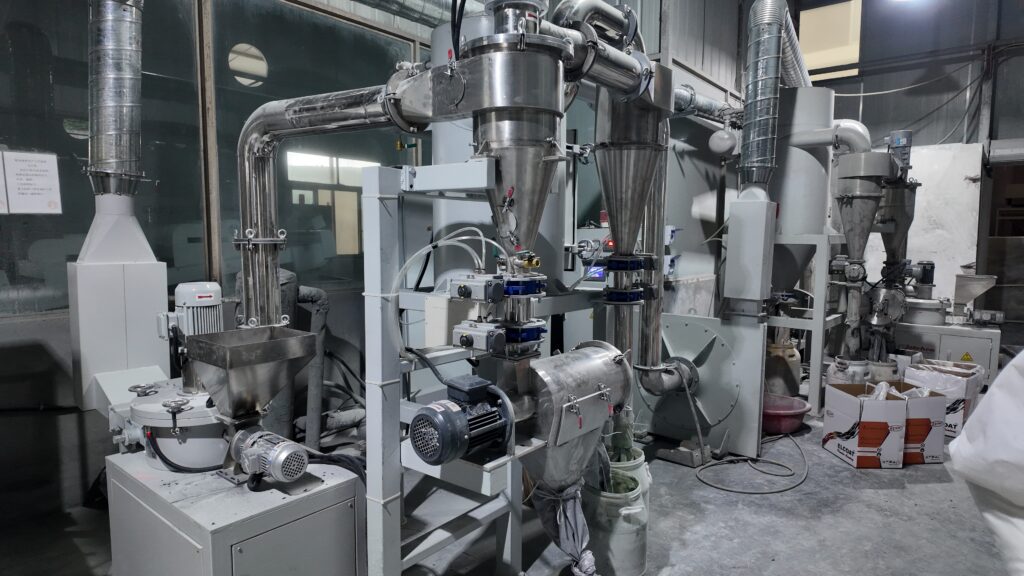
This is usually the first sign of summer trouble. You load fresh powder into the hopper, and instead of flowing like a boiling liquid, it sits there in lumps. The gun spits and surges. Film thickness goes uneven.
What’s happening: Powder particles are hygroscopic — they pull moisture from the air. Once relative humidity in your storage area or shop floor crosses 70%, fine particles start absorbing water. The powder gets sticky, flows poorly, and clumps at the pickup tube.
What to do about it:
- Store powder below 25°C and 60% RH. If you don’t have air conditioning in the powder room, a dehumidifier is the best money you’ll spend this summer.
- Seal opened boxes immediately. Don’t leave powder sitting in an open box on the shop floor overnight — transfer it to an airtight container.
- Use older powder first. Powder stored more than three months in humid conditions should be checked for fluidization before loading.
- Let cold powder acclimate. If powder comes from an air-conditioned storage room, let it sit in the shop for 30 minutes before opening to prevent condensation forming directly on the powder surface.
If clumping persists, sieve the powder before loading. It’s five minutes of work that can save a shift of frustration.
2. Pinholes in the Cured Film
Pinholes are the classic summer defect. Small circular craters appear in the cured coating, and operators start blaming the powder. In summer, the real cause is almost always moisture — but you need to check three sources, not just one.
What’s happening: Moisture trapped under or within the coating turns to steam during curing. The steam bursts through the film, leaving a crater. Summer makes this worse because humidity adds moisture at every stage.
The three moisture sources — and their fixes:
- Powder moisture: Already covered above. Clumped powder brings water directly into the coating.
- Compressed air water: This one gets overlooked constantly. High humidity loads up your compressed air system. If the air dryer is undersized or drain traps aren’t emptied, water droplets spray directly onto the part with the powder. Fix: Drain water traps every shift. Verify the air dryer dew point is -20°C or below. If you see moisture when blowing compressed air onto a clean rag, stop the line and fix it.
- Condensation on the part: Cold metal brought into a warm, humid booth forms a condensation layer instantly — like a cold drink can in summer. It’s invisible, but it’s there. Fix: If parts were stored in a cold warehouse overnight, run them through the oven at 80-100°C for 5-10 minutes before coating. It evaporates the surface moisture before powder hits the part.
3. Low Transfer Efficiency
You notice you’re reclaiming more powder than usual. Faraday cage areas — inside corners, deep recesses — are harder to cover. First-pass transfer efficiency drops.
What’s happening: High humidity kills electrostatic charge. Water molecules in the air act as tiny conductors, bleeding the charge off powder particles before they reach the part. Corona guns are especially affected.
What to do about it:
- Increase voltage: Run at 70-80 kV in high humidity. Watch for back-ionization — if it appears, back off slightly.
- Move the gun closer: Reduce gun-to-part distance to 150-200 mm. Less travel distance means less charge loss.
- Lower powder output: 150 g/min gives each particle a better chance of reaching the part.
- Consider tribo guns for critical parts: Tribo-charging guns are less affected by humidity and produce less Faraday cage effect. Worth it for complex geometries.
- If you can, condition the booth air: Even a dehumidifier in the powder management room makes a measurable difference. Ideal booth conditions are 20-25°C and 45-55% RH.
4. Orange Peel and Poor Flow-Out
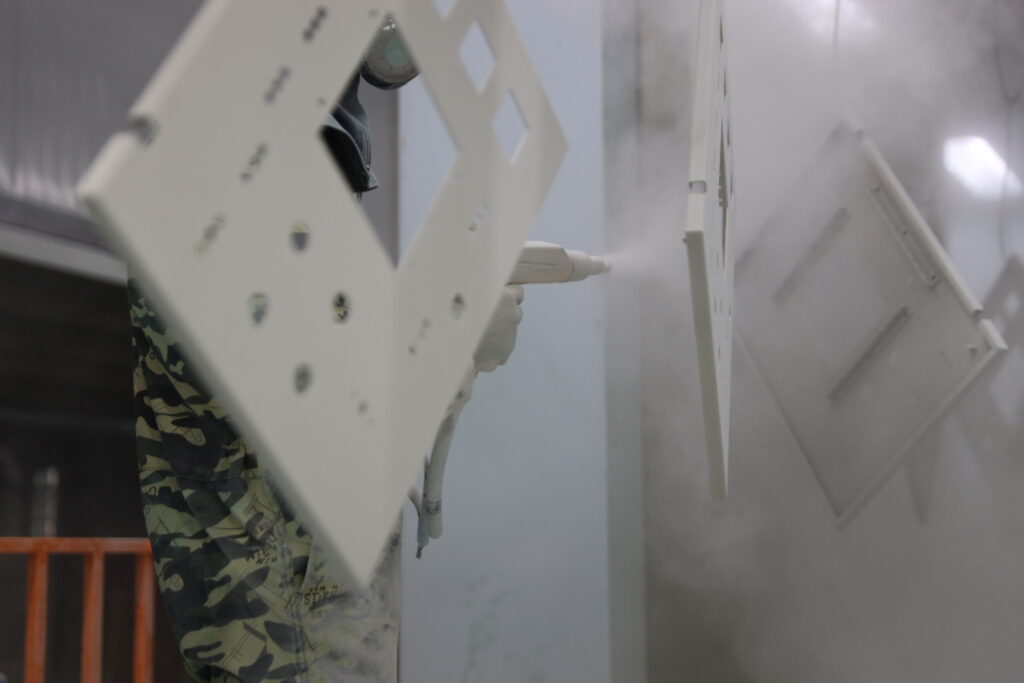
Summer heat changes how powder melts and flows. Orange peel that was barely noticeable in dry weather suddenly becomes obvious, especially on horizontal surfaces.
What’s happening: Two things. First, warm powder particles begin softening before they reach the oven, changing the melt-flow profile. Second, hot parts reach curing temperature faster, causing the coating surface to gel before the underlying layer has leveled — trapping texture on top.
What to do about it:
- Adjust oven ramp-up: If your oven has zone control, drop the first zone temperature by 10-15°C. Let the powder melt and level before crosslinking kicks in.
- Aim for the lower end of your thickness range: A slightly thinner film levels more evenly before gelling in hot conditions.
- Keep powder cool before use: Storing powder at 20-25°C before loading prevents particle softening in the hopper.
- Ask about summer-grade formulations: If your shop is in a consistently hot climate, a powder with enhanced flow additives makes a real difference. Our TropiCoat™ series is formulated with this in mind.
5. Inconsistent Curing
Summer can trick experienced operators. The shop is hotter, so parts must be curing faster — right? Not exactly.
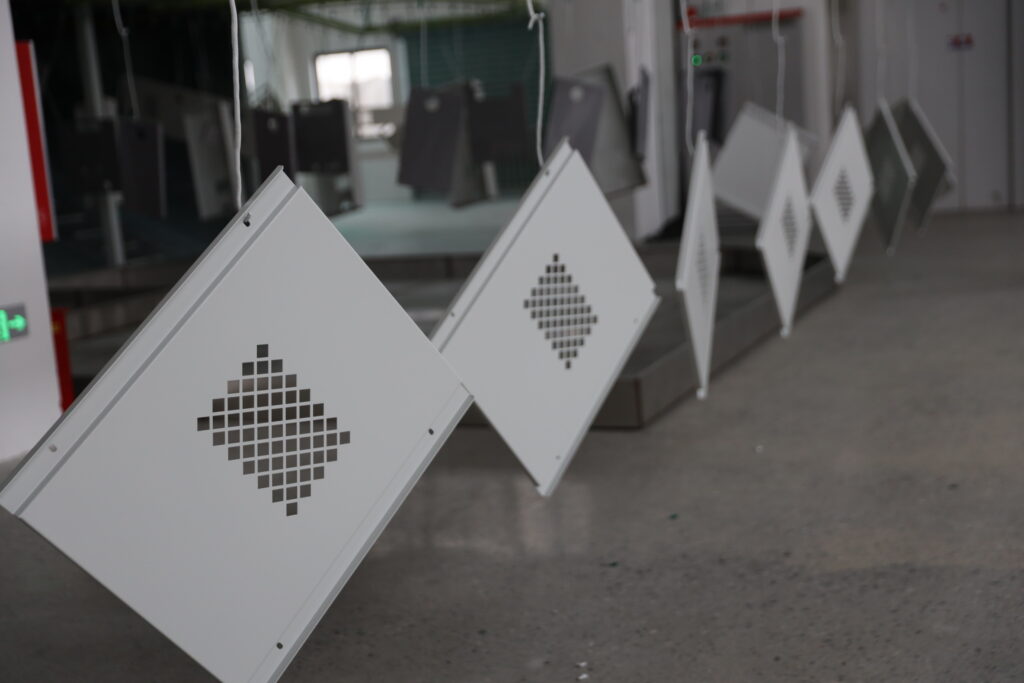
What’s happening: The main body of the part does reach temperature faster in summer. But thick sections, edges, and structural ribs still lag. When operators shorten dwell time based on “it felt hot enough,” under-cured edges result. On extremely hot days, older ovens may overshoot the setpoint, causing over-cure and yellowing on light colours.
What to do about it:
- Always measure metal temperature. Thermocouple on the thickest section. Oven air temperature tells you nothing useful in summer.
- Maintain full dwell time at target temperature. If your spec is 190°C for 15 minutes, the part needs 15 minutes at 190°C — not 15 minutes total in the oven.
- Check oven calibration monthly during summer. Ambient heat can push temperatures beyond setpoints.
- Let parts cool naturally after curing. Stacking hot parts straight off the line causes blocking and coating damage — and this effect is worse in summer.
6. Surface Condensation on Substrates
This is the problem most shops don’t diagnose until they’ve tried everything else. Parts come out of the oven with pinholes or delamination, and the powder and oven both check out fine.
What’s happening: Cold metal parts meet warm, humid shop air — and instant condensation. The dew point in a tropical workshop can be 28°C. If your parts are colder than that, moisture forms on the surface immediately.
What to do about it:
- Check the dew point. Measure substrate temperature and booth air temperature/humidity. If the substrate is at or below the dew point, condensation is forming. A dew point chart on the wall is a cheap, useful tool.
- Pre-heat cold parts: If parts are stored in air conditioning, move them to the booth area 30 minutes before coating, or pre-heat at 60-80°C for 10 minutes.
- Keep temperature changes gradual. The biggest problems happen when parts move from cold storage directly into a hot booth.
Summer Shop Floor Checklist
Print this and post it. Review it with your team at the start of hot season.
Every Shift:
- Drain compressed air water traps
- Verify air dryer dew point ≤ -20°C
- Log booth temperature and humidity (8am, 12pm, 3pm)
- Check first powder load for clumping or surging
- Measure metal temperature on parts entering oven
Every Week:
- Check powder storage: temp ≤ 25°C, humidity ≤ 60% RH
- Confirm all opened powder is in sealed containers
- Audit powder inventory — no stock older than 3 months sitting unused
- Verify oven temperature calibration
- Check reclaim powder condition — discard if clumpy or discoloured
Before Hot Season Starts:
- Service air dryers and replace filters
- Brief operators on summer-specific defects
- Stock spare dryer desiccant, gun nozzles, and sieve screens
- Discuss summer-grade powder options with your supplier
Powder coating problems in summer: Key Takeaways
Powder coating problems in summer are frustrating, but they follow the same script every year. Control moisture, and you control most of the defects.
Four actions that deliver the biggest impact:
- Fix your compressed air. Drain traps every shift. Verify dryer performance. This alone can eliminate half your summer pinholes.
- Pre-dry or acclimate parts. Five minutes of pre-bake saves hours of rework.
- Adjust gun settings for humidity. Higher voltage, closer distance, lower output. Simple changes, immediate results.
- Use the thermocouple. Never guess metal temperature in summer — the air temperature lies.
If you’re coating in consistently hot, humid conditions, ask your powder supplier about formulations built for that environment. Our TropiCoat™ series is engineered for shops that deal with humidity year-round — with better flow, anti-hydrolysis properties, and reliable performance in ambient conditions up to 35°C.
Frequently Asked Questions About powder coating problems in summer
Why does powder coating get pinholes in summer?
Pinholes are almost always moisture-related. Check three sources: powder moisture (clumping), compressed air water (drain traps, dryer dew point), and substrate condensation (cold parts in warm booth). Fix the moisture source, and the pinholes stop.
What humidity level causes powder coating problems?
Defects increase noticeably above 70% relative humidity. At this level, powder absorbs moisture, fluidization suffers, and transfer efficiency drops. Aim for 45-55% RH in the booth and below 60% RH in storage.
How should I store powder coating in summer?
Unopened boxes at 25°C or below, under 60% RH. Use a dehumidifier if needed. Once opened, transfer powder to an airtight container immediately. Practice FIFO and check powder older than three months before use.
Can I use the same powder in summer and winter?
Standard formulations work year-round, but gun parameters, pre-treatment, and oven settings need seasonal adjustment. For consistently hot, humid climates, summer-grade formulations with enhanced flow and moisture resistance offer measurable advantages.
Why is transfer efficiency worse in summer?
Humidity dissipates electrostatic charge. Water molecules in the air bleed charge off powder particles before they reach the part. Compensate with higher voltage (70-80 kV), closer gun distance (150-200 mm), and lower powder output (~150 g/min).
About TianMa Powder Coating
TianMa Powder Coating was founded in 1992 and is headquartered in Yueqing, Zhejiang, China. The company specializes in powder coatings for electrical cabinets, switchgear, industrial equipment, and architectural materials. It operates under an ISO 9001-certified quality system with an in-house testing laboratory. The TropiCoat™ series is formulated for hot and humid environments, delivering reliable fluidization and performance in ambient conditions up to 35°C and 85% RH. TianMa serves customers across Southeast Asia, the Middle East, Africa, and Central Asia.
For technical consultation or sample requests, contact the export department.