
A Story of Two Cabinets
Picture this: You’re standing in a solar farm somewhere in the Middle East. Two electrical cabinets sit side by side, installed on the same day three years ago. One looks almost new — the paint is still smooth, the color still holds. The other? Faded, chalky, starting to peel.
Same cabinet. Same environment. The only difference was the powder coating.
This happens more often than you’d think. Outdoor electrical cabinets in high UV environments — deserts, high-altitude regions, tropical climates — are brutal on coatings. And if you’re sourcing cabinets for a solar farm in Saudi Arabia, a telecom tower in Thailand, or a substation in Kenya, choosing the wrong powder coating can cost you years of maintenance headaches.
Let me walk you through what actually works.
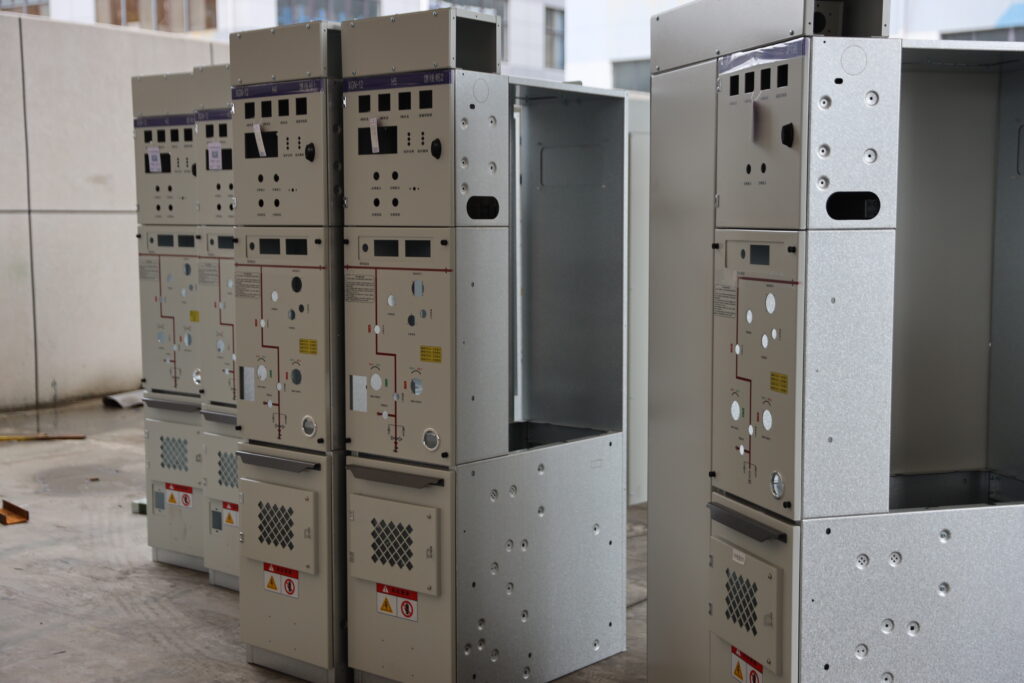
Why Desert and Tropical Climates Eat Coatings Alive
I’ve seen too many projects where standard indoor-grade powder coatings were used on outdoor cabinets. The results are always the same. Within two to three years, the coating starts chalking — that powdery white layer you can wipe off with your hand. Then comes fading, then peeling, then rust.
Three things are working against you:
UV radiation is the biggest killer. At high altitude, UV levels are 30-50% stronger than at sea level. In the Middle East, North Africa, or the Tibetan Plateau, the sun essentially breaks down the polymer chains in standard coatings. The coating loses its integrity from the top down.
Then there’s the temperature swing. A cabinet in the desert can hit 60-70°C on the surface during the day and drop below 10°C at night. That’s a 50-degree thermal cycle, every single day. Standard coatings can’t handle that expansion and contraction. Micro-cracks form, water gets in, and the damage accelerates.
And in tropical and coastal areas, humidity and salt spray add another layer of attack. Even a tiny pinhole in the coating becomes a highway for moisture to reach the metal substrate. Once corrosion starts under the film, it spreads fast.
So what’s the solution? Pure polyester powder coating.
Why Pure Polyester Is the Industry Standard
Not all powder coatings are created equal, and the type you choose matters a lot for outdoor use.
Pure polyester (TGIC or Primid cured) is the standard for a reason. It has excellent UV resistance built into its chemistry. The polymer structure is designed to withstand years of sunlight exposure without breaking down. It’s also flexible enough to handle thermal cycling without cracking.
Compare that to other types:
- Epoxy-polyester hybrid coatings are good for indoor use — they have nice mechanical properties and adhesion. But put them outdoors and they’ll start chalking within a year or two. They’re simply not designed for UV exposure.
- Pure epoxy has great chemical resistance but terrible UV stability. It’ll chalk and yellow within months outdoors.
- Polyurethane is actually good for outdoor use, but it’s significantly more expensive and harder to apply. Most manufacturers don’t stock it as a standard option.
Pure polyester hits the sweet spot: excellent outdoor durability, good mechanical properties (impact resistance, flexibility), wide color range, and reasonable cost.
At Tianma, our TM-P-6110 series is a pure polyester outdoor formulation. It’s been tested for over 1,000 hours of QUV accelerated weathering with minimal gloss loss. That translates to roughly 8-12 years of real-world outdoor performance in moderate UV climates, and 5-8 years in extreme high-UV environments.
The Numbers You Should Ask For
When you’re evaluating a powder coating supplier for outdoor cabinets, don’t just ask “is it outdoor grade?” — that tells you nothing. Ask for specific test data.
QUV accelerated weathering test (ASTM G154) is the most important one. It simulates years of UV exposure in a lab over a few weeks. If a coating can maintain 70% or more of its original gloss after 1,000 hours of QUV testing, it’s a solid outdoor performer. If it can do 1,500 hours with less than 30% gloss loss, that’s excellent.
Salt spray test (ASTM B117) measures corrosion resistance. For outdoor cabinets, you want at least 500 hours with no creepage from the scribe mark. 1,000+ hours is even better.
Impact resistance matters too — because cabinets get bumped during installation and transport. A good outdoor coating should withstand at least 50 cm·kg of direct impact without cracking.
If a supplier can’t provide these test reports, ask for a sample panel and test it yourself. A real sprayed panel tells you more than any data sheet.
Why RAL 7035 Is the Default Choice for Outdoor Cabinets
If you look at outdoor electrical cabinets across Asia, the Middle East, and Africa, the most common color you’ll see is RAL 7035 — light grey.
There’s a good reason for that. Light colors reflect heat, which helps keep the cabinet interior cooler. RAL 7035 is also one of the easiest colors to stabilize for UV resistance. Unlike bright reds or dark blues — which can be tricky to formulate for outdoor use — light grey performs consistently well.
We’ve supplied RAL 7035 as an outdoor powder coating for cabinets in these applications:
- Solar power stations across the Middle East
- Telecom tower cabinets in Southeast Asia
- Substation equipment in coastal Africa
In our own QUV testing, the RAL 7035 formulation in our TM-P-6110 series maintains over 80% gloss retention after 1,500 hours of accelerated weathering. That’s equivalent to about 8-10 years of real outdoor exposure in a moderate UV climate.
A Simple Checklist When Buying Outdoor Cabinet Coating
Next time you’re evaluating an outdoor powder coating for cabinets, run through this checklist:
- Confirm it’s pure polyester. Ask directly: “Is this pure polyester for outdoor use, or hybrid?” If the answer is “hybrid” or “epoxy-polyester,” it’s for indoor use only — don’t use it outdoors.
- Get the QUV test report. If they can’t or won’t provide one, that’s a red flag. Ask for a sample and test it yourself.
- Check salt spray hours. Minimum 500 hours for outdoor cabinets. 1,000+ hours is better.
- Verify the color is available in outdoor grade. Not all colors are. Bright reds, dark blues, and some specialty colors are harder to stabilize. Ask specifically.
- Request a sample panel. A real sprayed panel lets you check appearance, thickness, and flexibility firsthand. It’s worth the wait.
For a full step-by-step guide on evaluating suppliers, see our detailed walkthrough: How to Choose a Powder Coating Supplier.
The Real Cost of Outdoor Powder Coating for Cabinets: Not Just Per-Kilogram
Here’s something that often gets overlooked. Let’s take real numbers: a high-durability outdoor polyester for extreme climates (10-year lifespan) costs about $1.5-2.5/kg more than a standard outdoor-grade coating (5-year lifespan). That premium looks significant upfront, right?
But if you factor in the lifespan difference: the standard outdoor coating needs repainting every 5 years, while the high-durability coating lasts 10 years. Over a decade, you’re buying coating twice instead of once. Add in the labor cost for repainting, the downtime, the logistics — and the “cheaper” option ends up costing more.
For critical infrastructure like electrical cabinets, paying a bit more upfront for the right coating is not an expense. It’s an investment.
Looking for a reliable outdoor powder coating for cabinets? We supply outdoor-grade pure polyester coatings for switchgear manufacturers and distributors across Asia, Africa, and the Middle East. Get in touch — we’ll share technical data and sample panels.