
How to Choose a Powder Coating Supplier: A Practical 7-Step Guide
If you want to know how to choose a powder coating supplier, this guide walks you through every step. Choosing the right powder coating supplier affects your product quality, delivery schedule, and bottom line. Yet many buyers still select based on price alone — a shortcut that leads to inconsistent batches, hidden costs, and production downtime.
This guide gives you a clear, step-by-step method to evaluate and choose a powder coating supplier that fits your technical needs and budget. It’s written for manufacturers, job coaters, and distributors — whether you’re in Southeast Asia, the Middle East, Africa, or beyond.
Before contacting any supplier, know exactly what performance you need. The most common mistake in powder coating supplier selection is comparing prices before defining specifications. That leads to comparing incompatible products.
Pin down these three things:
- Application environment: Indoor or outdoor? Coastal or high-UV? This determines your resin type — standard polyester, super-durable, or specialty.
- Performance benchmarks: Write down your salt spray requirement (e.g., >500h or >1000h per ISO 9227), UV weathering needs, and mechanical properties like impact and flexibility.
- Certification requirements: Does your end-market demand ISO, Qualicoat, AAMA, or food-grade compliance? This narrows your supplier list immediately.
Step 2: Verify Manufacturer vs. Trader
One of the most critical steps in finding a reliable powder coating manufacturer is confirming you’re dealing with a factory, not a trading company. Traders add cost without adding quality control. When a batch has issues, you need direct access to the production team.
Four quick verification methods:
- Request the exact factory address — not “near Shanghai” or “in Zhejiang.” Verify it on Google Maps.
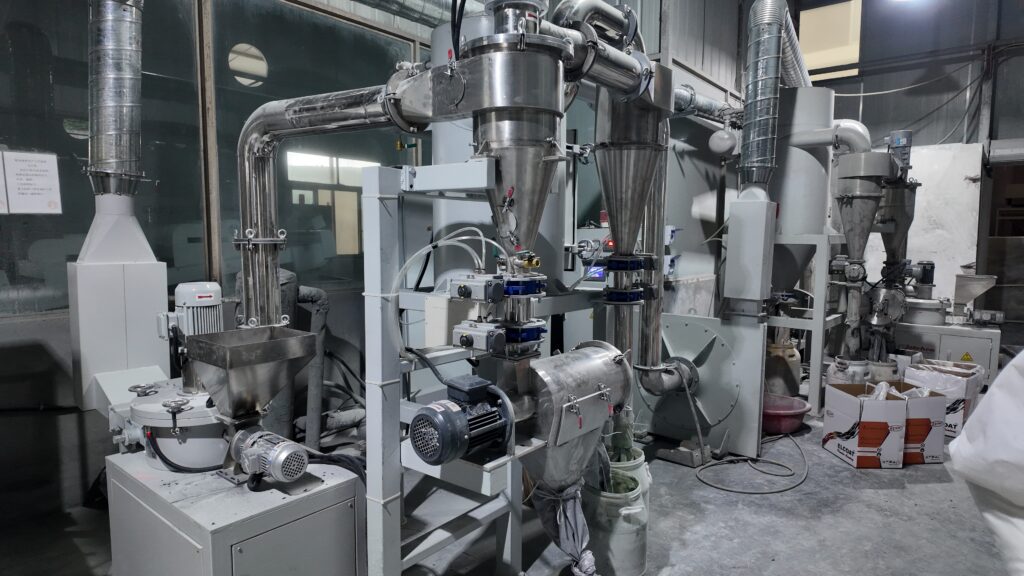
- Do a video walk-through of the production floor. Look for extrusion lines, mixing stations, and a testing lab. Pre-recorded videos don’t count.
- Check the business license. The registered scope should say “manufacturing,” not “trading.”
- Ask a technical process question. A manufacturer can explain their resin sourcing and quality checkpoints. A trader only quotes price.
A 10-minute video call at this stage can prevent months of problems later.
Step 3: Ask the Right Questions
The questions you ask during the inquiry stage reveal more than any certificate. Here are the essential questions to ask a powder coating supplier:
- “Can you share your ISO 9001 certificate and latest audit report?” Certification is a baseline. Recent audits prove the system is alive.
- “What salt spray and humidity test data do you have for the product you recommend?” If they can’t provide climate-relevant data, they haven’t formulated for your market.
- “What’s your typical response time for a technical complaint?” The answer should be specific: “Within 24 hours, with a video call.” Vague promises are a red flag.
- “Can you send a free sample within 5 working days?” Serious suppliers provide samples at no cost — if a supplier charges for a sample, they may not be confident in their product.
- “What’s your minimum trial order quantity?” 100–300 kg is typical. A full container demand for a first order is unreasonable.
These questions alone will filter out most opportunistic sellers.
Step 4: Audit Quality Control Processes
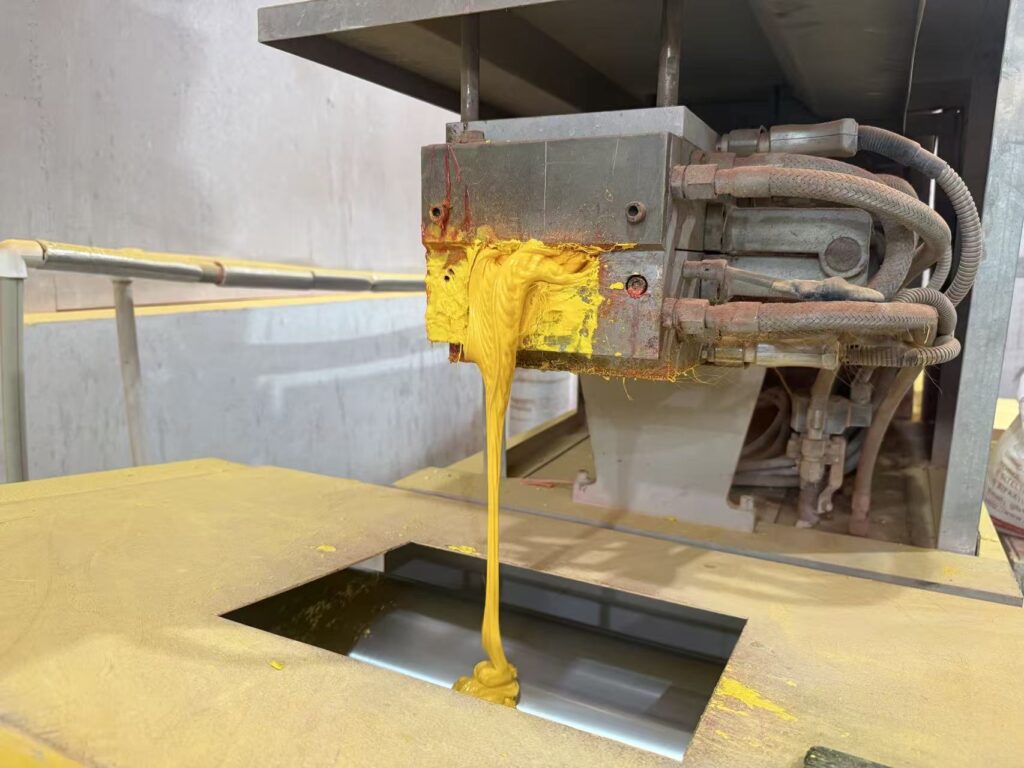
A supplier’s QC system is what ensures your batch three months from now matches the sample you approved today. During your call, probe these checkpoints:
- Incoming raw material inspection: Do they test every resin and pigment batch? Ask to see a recent resin certificate of analysis.
- In-process checks: Particle size, gel time, and cure behavior should be monitored during production, not just at the end.
- Final batch testing: Every batch should get a spray-out test for color, gloss, adhesion, and impact.
- Retained samples: Do they keep samples from each batch? This is essential for tracing quality disputes.
Documented QC procedures and retained samples are the hallmarks of a supplier you can trust over the long term. For more on climate-specific testing, see our guide on powder coating for hot and humid climates.
Step 5: Calculate Total Cost, Not Price Per Kilogram
The cheapest powder almost never gives you the lowest total coating cost. Instead of fixating on price per kilogram, calculate cost per square meter of finished product.
Variables that affect your real cost:
- Transfer efficiency: How much powder actually lands on the part? Higher efficiency means less waste.
- Specific gravity: Lower-density powder covers more square meters per kilogram at the same film thickness.
- First-pass yield: What percentage of parts pass inspection without rework? A powder that reduces rejects by just 5% can significantly improve your margin.
Ask your supplier to help you run this calculation. A partner who volunteers this is thinking about your business, not just their invoice.
Step 6: Assess Logistics and Supply Reliability
Even the best powder is useless if it arrives late or damaged. In fast-moving markets, supply reliability is a competitive advantage.
Key logistics factors:
- Lead time consistency: Does the supplier deliver within the committed window (typically 7–15 days)?
- Export packaging: Cartons or bags should be palletized and wrapped for sea freight. Request photos of export-ready pallets.
- Shipping terms: Understand FOB vs. CIF. For first orders, CIF may simplify your logistics.
- Certificate of Origin (Form E) : For ASEAN buyers, this can reduce or eliminate import duties under the China-ASEAN Free Trade Area. A supplier familiar with this saves you time.
Step 7: Test with a Trial Order Before Scaling
No research replaces running the powder on your own line, in your own environment. Before committing to large volumes, place a small trial order of 100–300 kg.
During the trial, observe:
- Application behavior: How well does the powder fluidize? Is transfer efficiency as claimed?
- Finish quality: Check color, gloss, and surface smoothness against your standard.
- Post-cure properties: Test adhesion, impact, and flexibility on actual production parts.
- Warehouse simulation: In humid areas, store coated parts for a week to check early water resistance.
A trial order tests both the product and the supplier’s service — documentation, shipping, and communication.
Knowing how to choose a powder coating supplier gives you a real advantage. At Tianma Powder Coating, we follow every step in this guide — ISO 9001 certified, in-house testing lab, and retained samples for every batch. Ready to test our powder? Contact us for a free sample.
Frequently Asked Questions
What is the most important factor when I choose a powder coating supplier?
Consistent quality, verified by in-house test data and batch records, matters most. Price is important, but it should not be the primary criterion.
How can I tell if a powder coating manufacturer is reliable?
Verify their factory via video call, request ISO 9001 certification with recent audit records, and confirm they retain samples from each batch. A reliable manufacturer like Tianma Powder Coating is transparent on all three.
What powder coating quality standards should I check?
Key standards include ISO 9227 (salt spray), ISO 2813 (gloss), ISO 2409 (adhesion), and ISO 1519 (flexibility). For architectural applications, AAMA 2605 or Qualicoat Class 2 are industry benchmarks.
What questions should I ask a powder coating supplier before ordering?
Ask for climate-specific test data, technical response time, minimum trial order quantity, free sample policy, and their process for handling batch quality issues.
Is it better to work directly with a manufacturer or through a trader?
Working directly with a manufacturer provides better technical support, faster problem resolution, and more consistent quality. A trader adds markup but rarely adds quality control capability. For a complete sourcing overview, see our ASEAN buyer’s sourcing guide.